
The Human Experience
five short stories about Nashville & calving

one.
This is the time of year when I find myself glued to the kitchen window. Our kitchen window faces north, toward the pasture holding the cows that will start calving this week. The cows won’t stay behind the house much longer, but for now, I’m watching and waiting for any signs of calving. The temps have been mild here, not nearly as cold as some Januarys. Like two Januaries ago, when Rich and I found a calf born at -40° in the middle of the night. (That was the actual temp, not with a wind chill.) I named him Lucky. This week, the cows will all be moved to the ranch yard, near the barn—three miles from our house—and out of my view. Nobody asked me to watch the cows, and it’s not even necessary that I keep an eye on them, especially since it’s not very cold. But I like to do it anyway. Thirteen years into farm life, and I still find the birth of a calf as exciting as I did that first winter on the farm. And maybe even more so, now that I’ve had my own babies. But for now, I patiently wait, watching through the window for the telltale marching of a cow along a fence line, to the more obvious sign of a cow lying down, her body contracting, to the most evident sign—a black calf on the ground.
two.
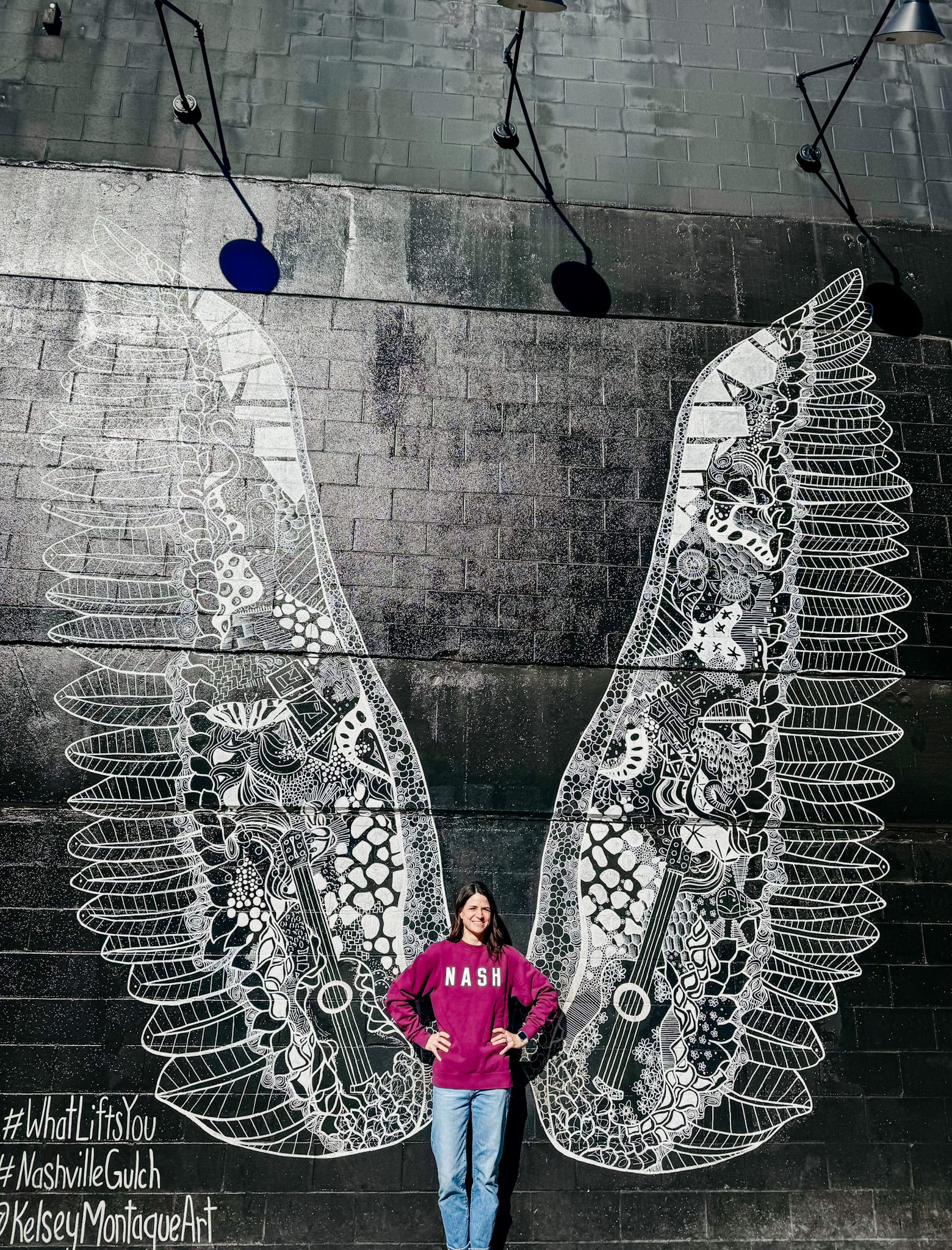
Two weeks ago, my husband and I traveled to Nashville for the first time. We went to watch a football game, but flew down a few days early to explore the city with friends. We took in all of the quintessential Nashville things—the bars on Broadway, Nashville hot chicken, the Country Music Hall of Fame, and live music at the Ryman Auditorium.
Everywhere we went, there was live music. We bought tickets in advance, so I knew we were going to see Vince Gill at the Ryman, and, of course, he was as amazing as I thought he would be.
But there was also Tyson, a pianist at Chiefs, who crushed it on dueling pianos. Two weeks ago, I had no idea who Tyson was. And today, I still don’t even know his last name. But I can still see his fingers flying across the ivory keys; his ability to play any song requested was mind-blowing. We saw many singers and bands at Jason Aldean and Kid Rock’s bars, all talented, but most people don’t know them by name.
Yet, they keep going out, night after night, singing and playing their songs and pursuing their dreams. I don’t know the statistics on how many people “make it” in Nashville. I assume, like a lot of things in life, some of it comes down to timing, being in the right place at the right time, along with talent, of course. Some might say it takes a little bit of luck.
We also met Robert, our server at a steakhouse, who regaled us with personal stories of Garth Brooks. Robert told us how he came to Nashville 30 years ago chasing his dream of being a songwriter. By the end of the evening, we were calling him Bob (he said that he was Robert at the restaurant, but Bob outside of work), and we kept asking him to tell us more and more stories. Stories we wouldn’t have heard if we hadn’t gone to that restaurant.
His stories got me thinking of the countless songwriters whose songs I know, but only by the artist who sings them. There are so many unsung heroes behind the hit songs, people who put words to notes and feelings to lyrics—people who will never see their name in lights.
After dinner at the steakhouse, Bob went outside and personally got us an Uber, then walked the ladies to the car, holding the door open for us. At the Ryman, we listened to several amazing artists, and Vince Gill was the final act. After Vince brought us to tears with “Go Rest High on That Mountain,” my husband looked at me and said, “Humans are the best.”
three.
I’m listening to the ranch crew chat on the radio about a cow who is marching around the pasture, showing signs of calving. She’s too far from the house for me to see, but I can picture her. I thought we were still days from the first calf, but it seems that today might be the day. The sun is shining, and the hills are brown; we haven’t had snow in weeks. It makes for good calving weather, but the fields and pastures need the moisture. Despite the warmer temperatures, we will still move the cows to the ranch yard near the barn so the cows can be monitored around the clock. Cows have their instincts, but occasionally, they need our help. For years, I’ve told my husband how women are necessary to the calving operation, because we actually know what it’s like to labor, to give birth, to be a mother. My human experience is different from his, and he agrees, knowing that I offer a perspective he will never fully understand.
four.
I’ve been trying to take the dog for a daily walk. Even though it isn’t cold, the wind blows every day. It seems worse this year than usual, but maybe I’m remembering wrong. But I do know that walking in the wind is worse than walking in frigid temperatures. I can bundle up against the cold, but I can’t do much about the wind. While walking the other day, I saw something black in the pasture ahead of me. As I got closer, it became clear it was two calves lying next to each other. They were dead. I wonder if I should tell this part of the story, but it’s real life on the ranch. I texted my husband, but he already knew about the loss. They were twins, born too early and unable to survive on their own. Someone would head out soon to pick the calves up and dispose of them. Rich rarely tells me about a calf dying. I think he knows it makes me a little sad. But also, death is occasionally part of ranch life, so he doesn’t think to tell me.1 As much as I know that humans are different from cows, I still sometimes try to put my human feelings onto animals. I can’t help but wonder if I had been paying more attention, if I would have noticed the calves being born, and if there was anything we could have done. Or if this was just Mother Nature’s way. When I’m back home from my walk, my husband assures me that the calves were born too early and that it wouldn’t have mattered if I found them right when they were born. But I still wonder.2 As much as I’ve learned to not personally take on all of the emotions of the losses, I hope to never become completely numb to them.
five.
We’ve been home from Nashville for nearly a week, and I’m still thinking about Tyson. I can’t stop thinking about how talented he is. And how I could have gone my whole life without knowing he existed, if it weren’t for a chance decision to go to Chiefs on that Friday night. I wonder what he dreamed of becoming as a kid. Did he grow up wanting to play the piano in bars? Did his mom force him to take piano lessons? Or did he dream of being a star, where everyone knew his name? I’ll likely never know or hear about him again, unless we go back to Nashville and he happens to be playing at Chiefs again. I only heard him play for a couple of hours, but I know I’ll never forget how his music made me feel.
I feel the need to say here that I’m really proud of our operation. During calving season, we usually have a 1% loss rate, which is very low. We do our best to save them all, but death is unfortunately part of life.
As I wrote this post, the ranch crew announced over the two-way radio that there was a calf in the pasture, trailing behind its mother. It’s officially calving season!
“I assume, like a lot of things in life, some of it comes down to timing, being in the right place at the right time…” — I often think of the vast amount of talent in the world and how so many will live mostly quiet lives. And I love how you wonder about people’s mothers and if they made them take piano lessons ♥️. I remember an Olympic commercial from years ago that showed clips of mothers taking their future olympians to all their practices, washing their uniforms, tending to their wounds. It makes me tear up just thinking about it. Another great piece of writing, Stacy! I always enjoy your farm life stories.
These stories, hope, death, birth, and the unseen parts are the truth we need woven together. My Aunty had highland cattle and my favourite part was going out after calving season to see the newborns.